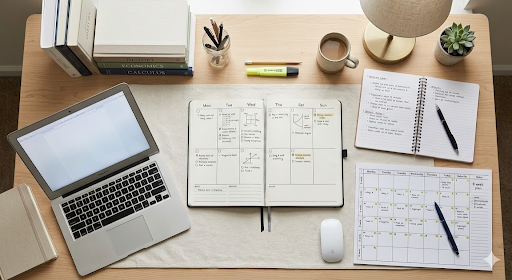
Why You Need a Study Plan
Without a plan, students often study randomly, skip important topics, and feel confused and stressed. A good plan helps you:
- Use your time wisely
- Stay focused
- Improve step by step
How Much Time Do You Need Daily?
You do not need 5-6 hours daily. Just 1-2 hours per day is enough if you study properly. Consistency is more important than long hours.
- Weekdays: 1-1.5 hours
- Weekends: 2-3 hours
Week 1: Understand the Exam + Basics
Goal: Know the exam pattern and your current level. Do not worry about your score - just understand where you stand.
- Learn Digital SAT format (Reading + Math)
- Take one full-length practice test
- Check your score and mistakes
- Identify weak and strong areas
Week 2: Build Strong Basics
Goal: Improve basic concepts. Focus on accuracy over speed and clear your concepts.
- Revise grammar rules (Reading section)
- Practice basic math topics
- Learn common question types
Week 3: Practice Reading Skills
Goal: Improve reading understanding. Read carefully and do not rush.
- Practice short passages daily
- Focus on main idea questions
- Learn to eliminate wrong options
Week 4: Improve Math Skills
Goal: Get better at math problem solving. Focus on understanding steps and avoid silly mistakes.
- Practice algebra, percentages, ratios
- Solve 10-15 questions daily
- Learn shortcuts and tricks
Week 5: Mixed Practice + Time Management
Goal: Handle both sections together. Focus on managing time and improving speed slowly.
- Practice Reading + Math daily
- Start timing yourself
- Take one practice test
Week 6: Identify and Fix Mistakes
Goal: Improve weak areas. Learn from mistakes and do not repeat errors.
- Review all mistakes from tests
- Practice weak topics again
- Take another full-length test
Week 7: Full Practice + Confidence Building
Goal: Feel confident before exam. Stay calm and build confidence.
- Take 2 full-length practice tests
- Practice under real exam timing
- Focus on accuracy
Week 8: Final Revision + Light Practice
Goal: Be ready for exam day. Stay relaxed and sleep well.
- Revise important formulas and rules
- Do light practice only
- Avoid learning new topics
Sample Daily Study Schedule for Busy Students
Here is a simple daily routine you can follow. This balanced routine helps you cover both sections without feeling overwhelmed.
- Weekdays (1-1.5 hours): 30 min Reading & Writing + 30 min Math + 15 min review mistakes
- Weekends (2-3 hours): Take a practice test or solve mixed questions, then review answers carefully
1. Study at the Same Time Every Day
Studying at a fixed time helps you stay regular and focused.
- Study at the same time every day
- Choose a time like after school or evening
- Follow the same routine daily
- Make it a habit like eating or sleeping
2. Avoid Distractions While Studying
Distractions can waste a lot of your time. When you sit to study:
- Keep your phone away
- Turn off notifications
- Do not open social media
3. Set Small Weekly Goals
Do not try to study everything at once. Instead, set small and simple goals every week. For example:
- Finish grammar rules this week
- Improve math accuracy step by step
- Practice 50 questions this week
4. Use the Right Study Material
Using the correct study material is very important. If you practice the right type of questions:
- You understand the exam pattern better
- You feel more confident
- You waste less time
5. Take Breaks When Needed
Studying for long hours without a break can make you tired. When you feel tired:
- Take a short break (5-10 minutes)
- Walk around or relax
- Then start again
Common Mistakes to Avoid
- Studying without a plan
- Ignoring weak topics
- Not reviewing mistakes
- Taking too many tests without analysis
- Last-minute heavy study
Final Thoughts
Preparing for the Digital SAT while managing school and other responsibilities may seem difficult, but it is completely possible with a clear plan and regular practice. This 8-week study plan is designed to save your time, improve your skills step by step, and build your confidence before exam day. You do not need to be a top student or study for many hours daily. Even 1-2 hours of focused study every day can lead to a strong score if you stay consistent.
Key Takeaways
- Just 1-2 hours of focused daily study is enough - consistency beats long irregular sessions.
- Start Week 1 with a diagnostic test to understand your baseline before studying.
- Alternate between Reading and Math practice daily to cover both sections evenly.
- Always review mistakes after every test - this is where real improvement happens.
- Week 8 is for light revision only - avoid new topics and focus on rest and confidence.